
Why Mineral County Has No One-Click Criminal History Search
Mineral County does not publish a single public name portal that joins Sheriff reports, jail intake, Justice Court matters, District Court files, and Nevada repository records. That is not a missing button. It reflects separate legal custodians. A Sheriff arrest report describes the incident and booking. A court file records the filed charge and outcome. The Nevada Department of Public Safety, Nevada State Police, Records, Communications and Compliance Division keeps fingerprint-linked statewide history, but the public may request only its own record through DPS-006.
The official Mineral County government site is the practical directory for local offices and services.
The county page confirms that Hawthorne is the center for the Sheriff and court counters, while the record itself must still be requested from the office that holds it.
Checking Criminal History in Mineral County
Start by defining the event and the record needed. A full legal name, any aliases, an approximate year, the place of the incident, the likely arresting agency, and a case or report number can help the custodian narrow a search. A date of birth may help distinguish similar names when the office permits its use.
- Identify whether Mineral County Sheriff, Walker River Tribal Police, Nevada State Police, or another agency created the incident.
- Call Hawthorne Township Justice Court for a misdemeanor, traffic, warrant, or preliminary matter, and call District Court for a filed felony or gross misdemeanor.
- Request the Sheriff report or booking record through the county form, email, phone, mail, or counter when the Sheriff holds it.
- Use NDOC only for a person sentenced to Nevada state prison, and use VINE for custody-change notifications.
- Order one's own fingerprint-based DPS-006 record when the goal is a statewide Nevada self-review.
A local search may require both courts because a serious case can begin with a Justice Court preliminary file and continue under a new District Court number. The NCourt link on the Justice Court page accepts payments. It is not a docket or pleading search.
Mineral County Records at 105 South A Street
Mineral County's record geography is compact even though the county covers 3,751.28 square miles. The Sheriff, county government, and Mineral County District Court operate from the courthouse complex at 105 South A Street in Hawthorne. District Court uses P.O. Box 1450 and (775) 945-0738. The Sheriff uses P.O. Box 2290 and (775) 945-2434. Hawthorne Township Justice Court is separate at 166 East Street, P.O. Box 1660, with (775) 945-3859.
Mineral County Sheriff
Incident, arrest, booking, jail, and dispatch records created by the agency. Call before visiting the Hawthorne counter.
Hawthorne Township Justice Court
Misdemeanors within its jurisdiction, criminal traffic, warrants, initial appearances, and preliminary proceedings.
Mineral County District Court
Felony and gross-misdemeanor prosecutions after bind-over, plus judgments, sentences, appeals, and sealing matters.
County offices post a Monday through Thursday schedule of 7:00 a.m. to 5:00 p.m. A specific records-window schedule is not separately published, so calling first matters, especially for a trip from Mina or Schurz.
Nevada Official Background Checks
Nevada has no open public statewide name search for criminal history. The official self-review route is the DPS-006 Identification File Request. The subject submits the completed form, an original certified rolled FD-258 fingerprint card, and an exact $27 certified check or money order to RCCD. The current form advises allowing about 45 days after receipt. A positive response contains the Nevada record; a negative response states that no Nevada record was located.
The process is limited to the subject's own Nevada history. It does not replace a certified Mineral County court disposition, and it excludes other states and FBI data. A direct FBI Identity History Summary is a separate nationwide subject request with an $18 federal fee and fingerprints. The FBI electronic ordering portal starts that process.
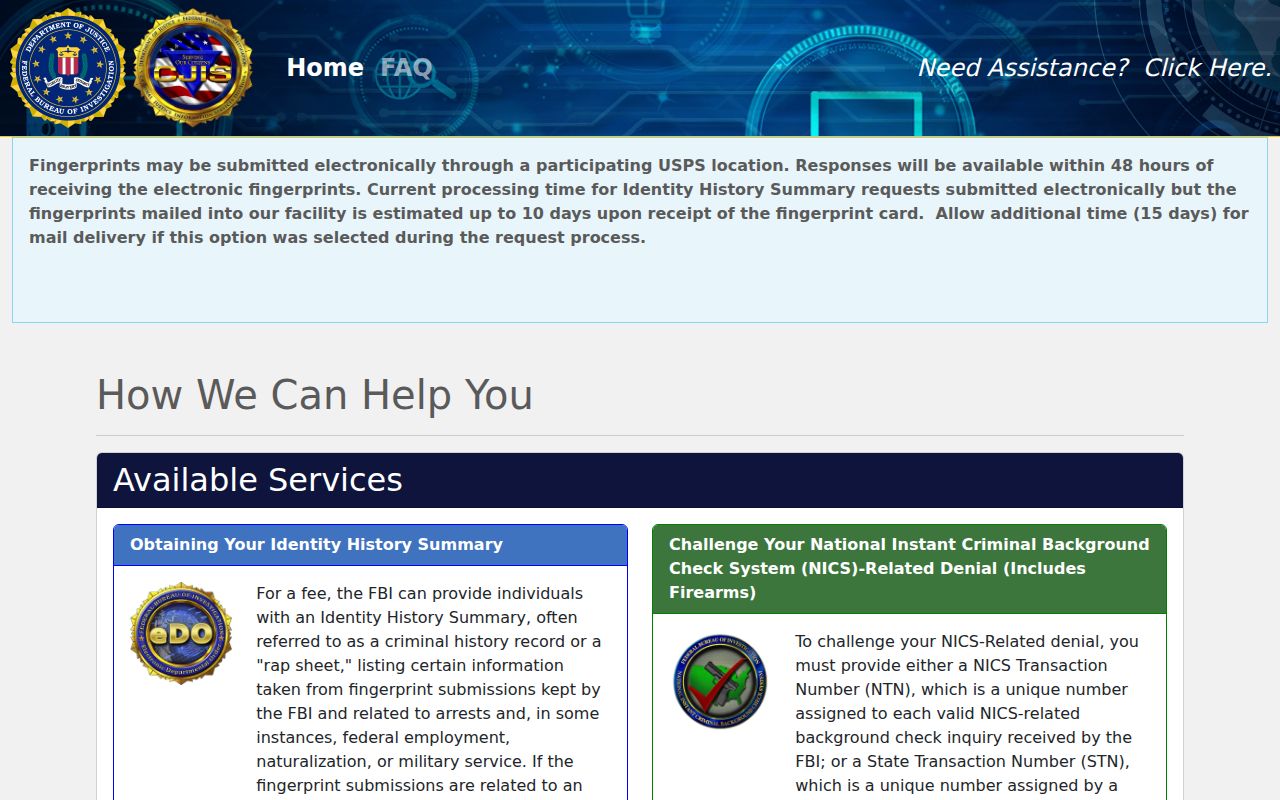
The federal portal produces an FBI identity-history result, not a Mineral County case file or a Nevada-only DPS-006 response.
| Official product | Fee | Required input | What it returns |
|---|---|---|---|
| Mineral Sheriff fingerprint card | $15 per card | Government photo ID | Printed card, not a history result |
| Nevada DPS-006 self-review | $27 | Original FD-258 and form | Nevada record or no-record letter |
| FBI direct summary | $18 | Subject request and fingerprints | FBI identity-history summary |
| Sheriff local inquiry | $5 | Identifiable local record | Sheriff-held material only |
Mineral County Fingerprint Records From Hawthorne to RCCD
The Mineral County Sheriff offers fingerprint cards at 105 South A Street. An appointment is recommended through (775) 835-4520 or nknight@mineralcountynv.org. The local fee is $15 per card, payable by cash, check to the Mineral County Sheriff's Office, or money order. Bring a current driver license, state ID, passport, or other government photo ID, along with any agency-specific card or form.
The official Mineral County Sheriff page connects readers to the local service directory.
The Sheriff rolls the prints and returns the card. It does not decide the state result. The subject then mails that original card with DPS-006 and the separate state payment to RCCD in Carson City.
Keep the products straight. The $15 service creates a fingerprint card, the $27 request returns one's Nevada record, and the $5 Sheriff inquiry concerns local agency records.
Criminal Record Types
Each Mineral County record answers a different question. The creating agency holds the incident narrative. Sheriff detention keeps county booking and custody data. Justice Court and District Court keep their own dockets and case documents. RCCD links qualifying fingerprint-supported Nevada arrest cycles with reported outcomes. NDOC covers state-prison sentences rather than new county arrests.
Warrant, supervision, and registry information add still more custodians. A warrant begins in a court file but service and custody details may sit with law enforcement. Nevada's Division of Parole and Probation supervises probationers and parolees, while the Board of Parole Commissioners makes parole-release decisions. The public sex offender registry is a community-notification product with statutory limits, not a full criminal-history report. These distinctions explain why a name found in one official tool may be absent from another.
- Incident or arrest report
- The originating agency's account of alleged conduct, people, place, evidence, and probable cause, subject to lawful redaction.
- Booking record
- Sheriff intake data such as booking date, arresting agency, initial charge or hold, bond, custody status, and release.
- Court case file
- The filed complaint, information or indictment, docket events, pleas, motions, judgment, sentence, and later orders.
- Nevada repository record
- A subject-only, fingerprint-linked state history that may contain qualifying arrest cycles and reported dispositions.
- Custody locator record
- NDOC or federal prison information, which does not substitute for a county jail roster or local court file.
Three Mineral County Records From One Arrest
One arrest can create several records that update at different speeds. The officer's agency writes an incident or arrest report. Sheriff detention creates a booking entry, photograph, fingerprints, charge or hold, and release status. The court then opens a docket for the initial appearance and any prosecution. Qualifying prints may reach RCCD, and the eventual disposition should be reported back to the repository.
A dismissal or acquittal does not instantly remove every source copy. Read the court disposition before describing an outcome, and use the correct Nevada sealing procedure when an eligible record should be restricted.
Inside a Mineral County Criminal Record
A Nevada repository record often groups identifiers with fingerprint transactions, arrest charges, dispositions, and custody or supervision updates. A Mineral County case file places more weight on the case number, filed counts, docket, counsel, hearings, judgment, and sentence. A booking entry focuses on intake and present custody.
| Name and identifiers | Legal name, aliases, date of birth, physical descriptors, and SID or FBI identifiers when the record type permits them. |
|---|---|
| Arrest and booking data | Agency, date, transaction, booking number, initial charges, holds, bond, release, and fingerprints. |
| Charges and statutes | Count number, Nevada citation, description, classification, and any amended or dismissed status. |
| Disposition | Dismissal, acquittal, plea, verdict, conviction, or another recorded resolution for each count. |
| Sentence | Custody, probation, fines, assessments, restitution, and other court orders when public. |
| Custody or supervision | Booking, prison, release, parole, or probation information held by the responsible agency. |
Protected identifiers, victim or minor details, medical material, juvenile records, sealed content, and active investigative information may be withheld or redacted.
Mineral County Jail and Custody Records
No official Mineral County online jail roster or daily booking log was located. For current county custody, call the Sheriff at (775) 945-2434. For a releasable booking record, use publicrecords@mineralcountynv.org or the web form. VINE at 1-888-268-8463 offers free custody-change notifications, but it is not the official case disposition and should not be the sole basis for a safety decision.
The official NDOC Inmate Search is useful only when a Nevada state-prison sentence may exist.
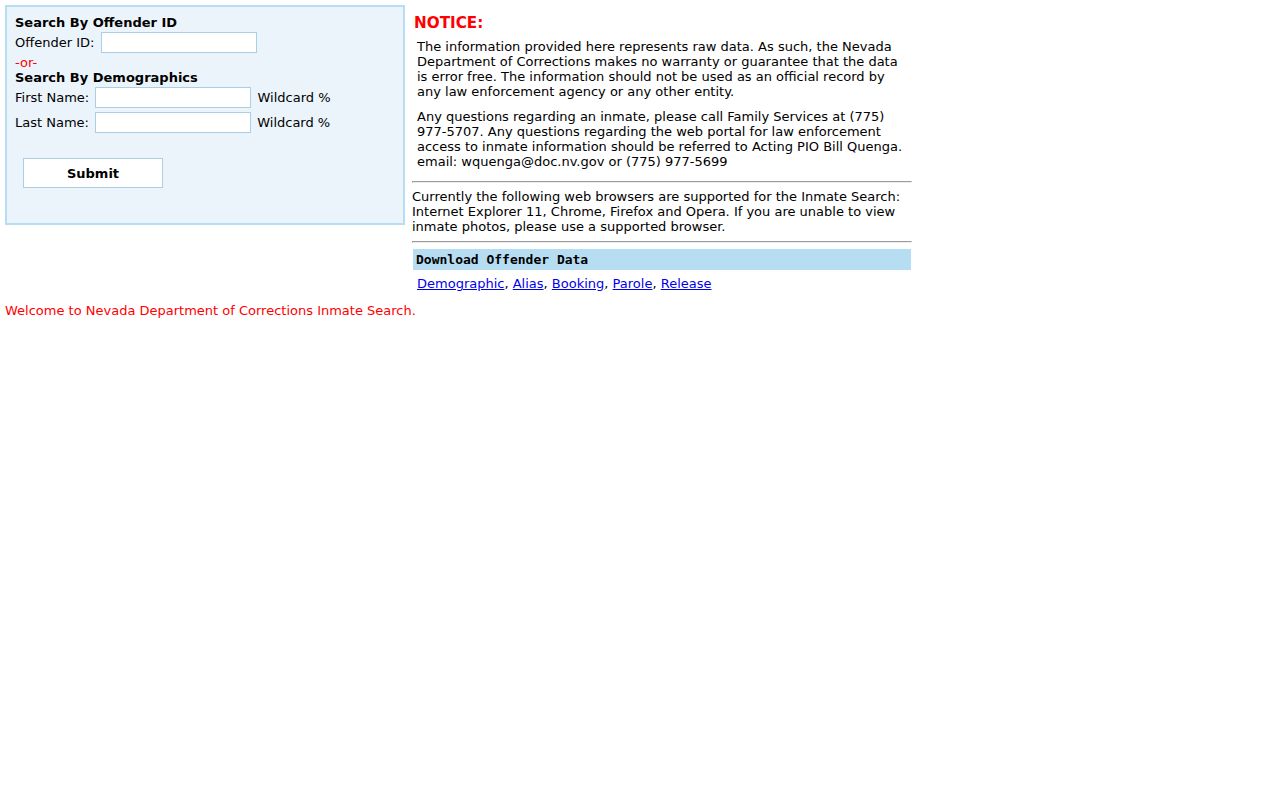
NDOC accepts an offender ID or a name search and offers demographic, alias, booking, parole, and release data. It generally omits recent arrestees, people awaiting trial, probation-only matters, and current county jail detainees.
Public Access Laws in Nevada
The Nevada Public Records Act makes government records open unless another law makes them confidential. A request should identify an existing record and go to the custodian that holds it. Under NRS 239.0107, the office generally must respond through one of the statutory paths by the end of the fifth business day. That may mean producing the record, stating that it is not held, giving a date when it expects access, or citing the authority for confidentiality. It is not a promise that every large request will be completed in five days.
Public access does not erase privacy rules. Active-investigation facts, juvenile files, sealed records, victim and minor identifiers, medical data, and nonpublic repository history may be withheld. When only part of a report is protected, ask the custodian to release the reasonably segregable remainder. Court records also remain subject to sealing and redaction rules. Registry data carries its own lawful-use limits and should be used only for public safety and community awareness.
Key Statutes:
NRS 239.010 and 239.0107 set the public-access rule and the custodian's response framework.
NRS 179A.100 and 179A.150 govern criminal-history dissemination and a subject's inspection right.
NRS 179.245 and 179.255 govern sealing after eligible convictions or favorable terminations.
NRS 179B.250 and 179B.270 define public registry information and restrict specified uses.
NRS 179D.113 through 179D.490 establish Nevada registration, tier, verification, and notification rules.
Mineral County Public Records Request Fallback
The Sheriff's web form is the main online fallback where no local case, warrant, or booking database exists. A useful request describes the incident, approximate date and time, location, agency, report or booking number if known, exact portions wanted, and preferred format. The form also asks for the requester's name, address, daytime phone, and email. Direct email may be sent to publicrecords@mineralcountynv.org.
The Sheriff's records page lists a $5 fee for a requester who is not affiliated with a partner agency. It does not publish a per-page, certification, audio, or video schedule, so ask for an estimate before authorizing chargeable work. A requester may also call (775) 945-2434, visit after confirming availability, or mail the request to P.O. Box 2290.
If part of a record is withheld, ask whether the office can release segregable nonconfidential portions. A court case file must go to the court, a Walker River Tribal Police report must go to that tribal agency under its own process, and a statewide rap sheet must go through RCCD.
Sealed, Expunged, and Restricted Records
Nevada uses the term record sealing, not expungement. Sealing removes eligible information from ordinary sources and restricts dissemination, but it does not destroy the record. Courts, repository staff, and other users authorized by law or court order may retain limited access. Juvenile material, protected victim or minor information, medical and identity data, sealed warrants, and nonpublic repository records are also outside routine public access.
A Mineral County sealing review starts with one's DPS-006 history and certified dispositions from Hawthorne Justice Court or District Court. The person must compare each matter with the current NRS 179.245 or 179.255 rules, prepare the petition and related papers, use the court with jurisdiction, provide materials for prosecutorial review, and distribute a signed order to every listed agency. RCCD states that the overall process often takes two to four months and that repository implementation can take longer after receipt.
A dismissal does not automatically seal the arrest. Current statutes control eligibility, waiting time, and exclusions, so the final filed judgment and the latest Nevada law matter more than an old chart.
Mineral County Warrant Records Without a Public Database
No official Mineral County active-warrant public database or most-wanted list was found. For a warrant tied to a Justice Court docket, call (775) 945-3859. For a District Court criminal case, call (775) 945-0738. The Sheriff at (775) 945-2434 may address service or custody information, while Walker River reservation matters may require the tribal police or court.
A bench warrant often follows a failure to appear or obey a court order. An arrest warrant rests on judicial probable cause. A search warrant authorizes a search and is not a conviction. Search warrants, sealed indictments, juvenile matters, officer-safety information, and active investigative details may not be publicly confirmed.
Federal matters use a different system. The PACER service holds federal court dockets and documents.
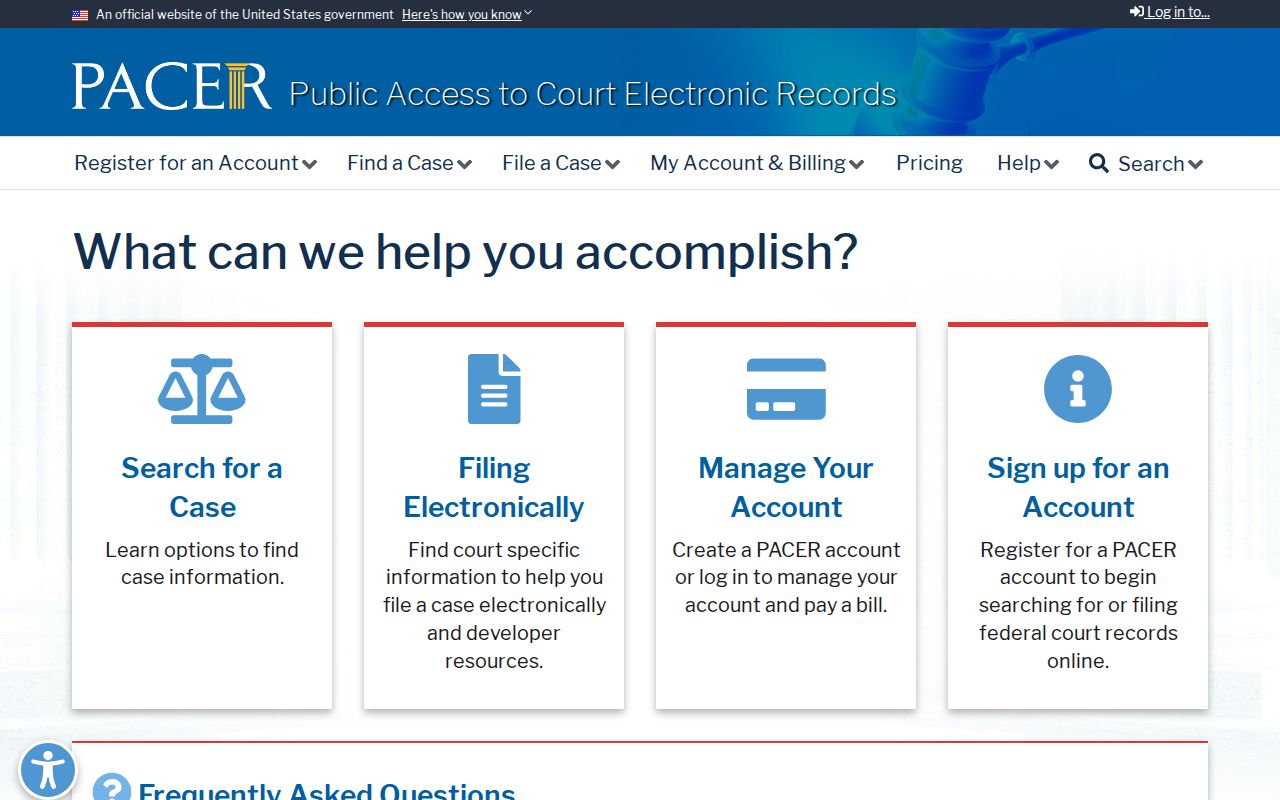
Mineral County lies in the U.S. District Court for the District of Nevada, so a federal case is not filed with the Mineral County clerk.
The District of Nevada court website supplies the court's official local information.
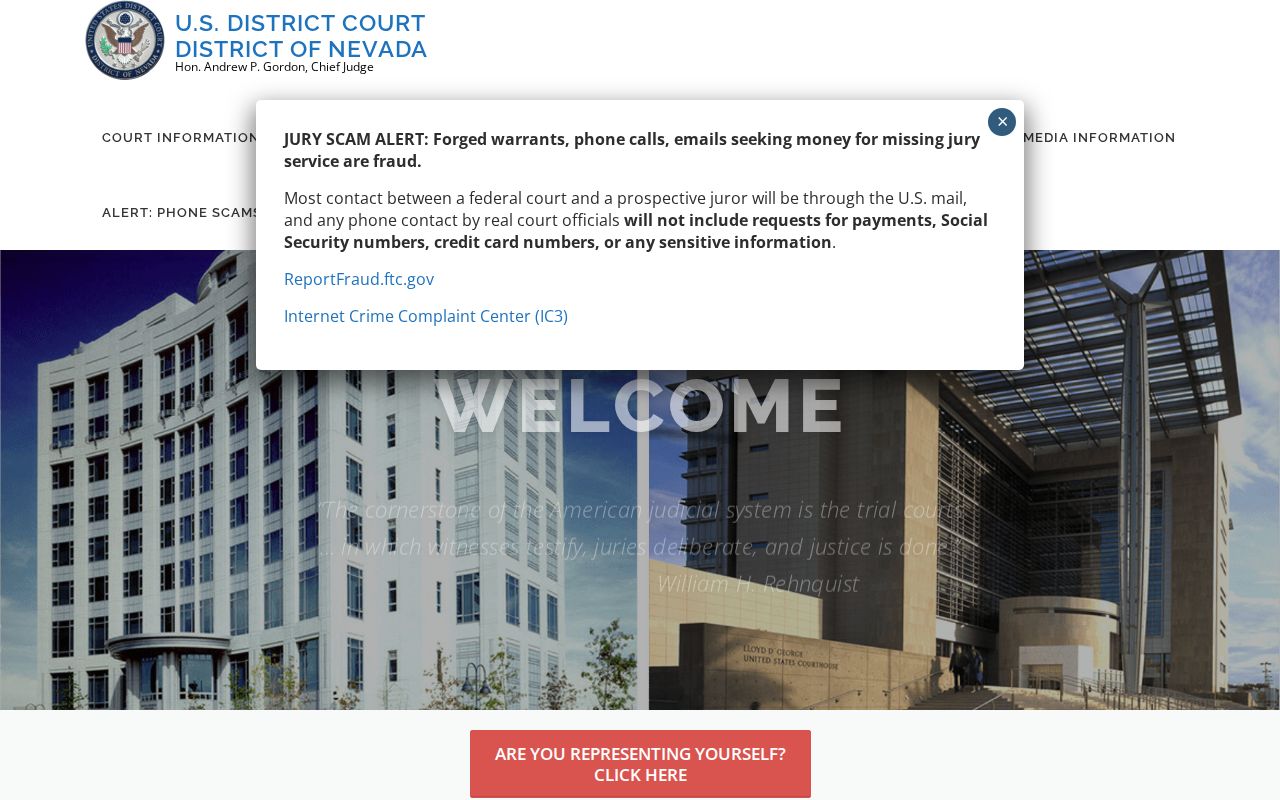
The federal court site and PACER should be used together when the alleged matter falls under federal rather than county or state jurisdiction.
Mineral County Criminal Records by City
Mineral County has no incorporated cities, municipal police departments, or municipal courts. These local guides cover its three largest census-designated communities without treating them as incorporated places. Hawthorne relies on the Sheriff and county courts. Schurz first requires the reader to identify whether Walker River Tribal Police, the Sheriff, Nevada State Police, or a federal agency created the record. Mina depends on Hawthorne-based county offices and benefits from phone, email, and mail access before a long trip.
Hawthorne Criminal Records
2020 Census count 3,118. Sheriff and county court counters serve the county seat.
Schurz Criminal Records
2020 Census count 656. The Walker River Reservation changes which agency holds a report.
Mina Criminal Records
2020 Census count 127. County and state channels replace any city-level office.